“When the Mind Whispers, ‘You’re Sick’… But the Body Isn’t Listening”
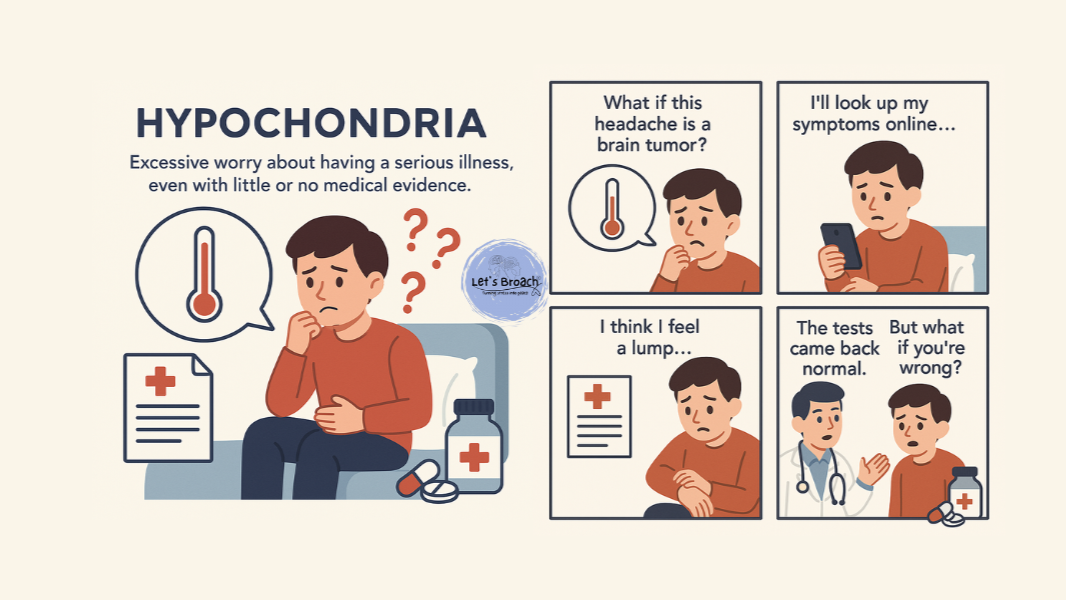
Ever Googled a headache and convinced yourself it’s a brain tumor? Ever had a harmless twitch and thought, “What if it’s neurological?” Or Googled a cough until you convinced yourself you had lung cancer?
Welcome to the twisted world of Hypochondria — now called Illness Anxiety Disorder.
It’s not drama. It’s not attention-seeking. It’s anxiety — not just overthinking, but a constant, unsettling belief that something is horribly wrong with your body. The fear of illness becomes so overwhelming that it often eclipses any actual symptoms. The body may be perfectly fine, but the mind can’t help but spiral into worst-case scenarios, making the worry feel very real, even if the sickness isn’t.
The term “Hypochondria” has its origins in Ancient Greece. Hippocrates first used it to describe a pain in the upper abdomen, just beneath the ribs — an area known as the hypochondrium. Over time, however, something unusual began to emerge: people started reporting this pain without any identifiable cause. It wasn’t physical illness they were experiencing, but a deeply ingrained fear of it. And so, the meaning of the term morphed — from physical discomfort to a psychological struggle.
What was once seen as mere imagined illness is now understood as something much more profound. Today, Illness Anxiety Disorder (IAD) reveals itself not just as a fear of sickness, but as a mental health condition where the mind latches onto the idea of disease, even when the body remains healthy. It’s a constant mental tug-of-war — the body unaffected, yet the mind imprisoned by the possibility of an unseen illness lurking just around the corner.
Illness Anxiety Disorder affects an estimated 3-10% of the population at some point in their lives. But many of those who struggle with it suffer in silence, afraid of being misunderstood or labeled as overly dramatic, attention-seeking, or “crazy.” They aren’t looking for sympathy; they are trapped in a constant, looping fear that their body is betraying them, even when their health checks out. It’s a fear that can paralyze every aspect of life, and it’s often invisible to those around them.
The origins of Illness Anxiety Disorder are multifaceted. Research indicates that genetics plays a role, especially in people with a family history of:
- Anxiety disorders
- OCD (Obsessive-Compulsive Disorder)
- Depression
But it’s not just about genes. Life experiences can also trigger this anxiety. Losing a loved one to a sudden illness, growing up in a household where health worries were the norm, or witnessing a family member’s long-term battle with illness can leave a lasting imprint. These experiences “train” the brain to be hypersensitive to health-related fears, making the fear of illness feel much more real than it actually is. It’s the mind constantly looking for danger, even when the body is perfectly fine.
For those with Illness Anxiety Disorder, the fear of sickness isn’t abstract—it feels physically real. The anxiety manifests in tangible ways, from unexplained aches to breathlessness or fatigue. Even though there’s no diagnosable illness, the suffering is profound. It’s a daily battle that might look like:
- Constantly seeking reassurance from doctors, but never feeling satisfied
- Checking their body obsessively for any sign of disease, even if tests come back negative
- Avoiding places or situations that might trigger panic, like hospitals, doctor’s offices, or even the news
- A nagging belief that doctors missed something critical, or that it’s just too early to detect the disease.
Even after tests confirm nothing is wrong, the fear doesn’t fade—it mutates. “Maybe they missed something. Maybe it’s just too early to tell. Maybe I’m the exception.” The cycle continues, relentless and unyielding.
Let’s Get Real — It Happens More Than You Think
It might seem like an extreme scenario, but it’s happening more often than you realize:
Riya, 34, came down with a simple cold after a trip. Two weeks later, she was convinced it was long COVID, even though every test came back clear. Yet, the fear lingered, gnawing at her.
Jay, 28, starts each evening by scrolling through health forums, where a minor chest ache turns into a fear of heart disease, even though all his checkups are fine. The anxiety consumes him, leaving him exhausted and drained.
Ananya, 40, avoids hospitals—not because she’s strong, but because she knows the moment she steps inside, panic will take over. It’s not about physical illness; it’s about the mental battle that takes over her body’s every reaction.
It could be you. Or someone you care about. It’s time to stop ignoring it and start talking about it, because this is real, and it affects more people than we think.
Why Does It Happen?
Illness Anxiety Disorder (IAD) isn’t just about overthinking or being overly cautious—it’s your brain working overtime. Research shows that early experiences with illness or trauma can shape how we perceive health risks. Growing up with a chronically ill parent, or even losing someone suddenly to illness, can heighten sensitivity to health concerns, causing the brain to be on high alert. This heightened sensitivity is often tied to the anterior insula, the part of your brain that monitors your body’s internal state. When this area becomes hyperactive, it can trigger an exaggerated sense of danger, leading to a constant state of vigilance.
But it doesn’t stop there. Difficulty tolerating uncertainty plays a big role. For some, the brain becomes fixated on “what-ifs” and worst-case scenarios, which only fuels anxiety further. Your brain essentially becomes a hyper-vigilant bodyguard, scanning for threats—even when there’s no danger at all. This constant monitoring can feel overwhelming, like you’re perpetually on guard, waiting for an illness that may never come. It creates a vicious cycle: the more you monitor, the more anxiety builds, and the more real the fear feels. The brain’s natural response to protect you ends up making things worse, leaving you trapped in a loop of fear and uncertainty.
When Does Concern Become a Disorder?
Health anxiety crosses into a disorder when it starts disrupting your life. If you find yourself constantly checking your body for symptoms—whether it’s lumps, rashes, or anything else—or obsessively Googling health concerns for hours, it’s time to pause and reflect. If you’re avoiding hospitals or, conversely, visiting them repeatedly for reassurance, this is a red flag. Similarly, if you distrust normal health reports and need constant reassurance, or if your daily life becomes stressful or dysfunctional because of your health fears, it’s crucial to seek support.
It’s normal to have health concerns from time to time, but when fear controls your thoughts and behavior to the point of distress, it’s no longer just anxiety. It becomes a disorder that can deeply impact your life. Recognizing when concern turns into something more serious is the first step towards reclaiming control.
This isn’t about fixing something broken — it’s about learning to understand and manage the brain’s overactive defenses, so you can reclaim your peace of mind. There is hope, and it’s entirely possible to break free from the grip of constant fear.
Can You Manage It on Your Own?
The good news? You can take steps to manage health anxiety on your own—at least in the beginning. Think of it like training a muscle: with consistent effort, you can strengthen your ability to manage the fear without letting it control you.
Start with mindfulness. It’s not about stopping the thoughts or pretending they don’t exist, but learning to observe them without judgment. Picture this: You’re sitting at your desk, and suddenly a worry about a potential health issue creeps into your mind. Instead of spiraling into a full-blown panic, mindfulness teaches you to simply notice the thought and let it pass, like watching a cloud float by.
Limiting online health searches is another game-changer. You know the drill: Google something once, and next thing you know, you’re down a rabbit hole, reading about every worst-case scenario imaginable. By setting boundaries—like telling yourself you’ll only check once a day, or not at all—you can regain control over your time and avoid fueling the anxiety.
Journaling also plays a powerful role in separating fear from fact. It can be incredibly freeing to write down your thoughts, externalizing what’s going on in your mind. With time, you may start to recognize patterns and realize that many of your worries are based on what could happen—not what’s actually happening. This small shift can make a world of difference.
And then there’s the structure: Routine health checks, done regularly but not obsessively, can help provide reassurance without the spiral. It’s about balance—acknowledging your fears while still moving forward with your daily life. Throw in a “digital detox” from triggers like medical forums or social media groups that feed your anxiety, and you’re already building a toolbox to handle the stress.
But here’s the truth: managing health anxiety on your own works for some—but not for everyone. It’s okay to admit when the anxiety is too much. If these strategies aren’t cutting it, or if your mind is constantly consumed with worries, it might be time to seek professional help.
When to Seek Professional Help
Sometimes, the fear takes over so completely that it feels like there’s no way out. If your mental peace is constantly interrupted by health fears, if your relationships or work are suffering, or if reassurance from others no longer provides lasting relief, it’s time to pause and ask for help. You’re not alone in this, and reaching out is a sign of strength, not weakness.
Cognitive Behavioral Therapy (CBT) can work wonders in retraining those anxious thought patterns, helping you break free from the cycle of worry. Think of it as a personal trainer for your mind—helping you strengthen the skills you need to challenge irrational thoughts and focus on what’s real. In some cases, doctors might also recommend medication, such as SSRIs, to help balance out the anxiety and give you a bit of breathing room while you work through it.
It’s important to remember: You don’t have to fight this alone. Whether you try self-management techniques first or go straight to therapy, there is always a path forward. The key is recognizing that this anxiety doesn’t define you—and with the right support, you can regain control over your life and start living without the constant worry about your health. The power is in your hands, and you are capable of making it through.
Illness Anxiety isn’t a fabrication of your mind. The fear you feel is genuine—your body responds as though it’s in immediate danger, even when there’s no real threat. It’s the brain’s natural response to uncertainty, but sometimes it goes into overdrive, misinterpreting signals and creating a false sense of alarm. What happens next? The cycle of anxiety begins, making everything feel more intense than it truly is.
This is where the fascinating power of psychology and neuroscience comes in. The brain, in all its complexity, is adaptable. It can be rewired. Neuroplasticity—the brain’s ability to change and grow—means that with the right tools and support, you can teach your mind to pause, breathe, and see the situation more clearly. Imagine your brain as a highly skilled but overly cautious guard dog. With practice, you can train it to relax, to stop barking at every shadow, and to only react when real danger is present.
It’s also a reminder of a powerful philosophical truth: our thoughts don’t define us. We are not our fears. The brain might be wired to scan for threats, but we hold the keys to how we respond. We can choose to challenge those thoughts, to question their validity, and to stop magnifying them into something bigger than they are.
The journey forward is about reframing the story your brain is telling you. It’s not about erasing the fear, but understanding it, questioning it, and gradually learning how to quiet the inner noise. With time, therapy, and the right mindset, you can break free from the grip of constant worry. You’re not bound to live in the shadow of “what-if.” Instead, you can reclaim the present, focusing on what is—and with that, peace of mind becomes possible.